Other people... treasure memorable moments in their lives: the time one climbed the Parthenon at sunrise, the summer night one met a lonely girl in Central Park and achieved with her a sweet and natural relationship, as they say in books... What I remember is the time John Wayne killed three men with a carbine as he was falling to the dusty street in Stagecoach... Walker Percy, The Moviegoer
William S. Hart (1864-1946)
The Authentic West
I don't know how much the Western film means to Europe; but to this country it means the very essence of national life. I am referring now to the later frontier-- the frontier of the range and the mining camps, with all its youthful follies and heartbreaks and braveries that we know and love best. It is but a generation or so since virutally all this country was frontier. Consequently its spirit is bound up in American citizenship. William S. Hart, 1916
Broncho Billy Anderson (1882-1971)
The First Western Star
Search This Blog
Tom Mix (1880-1940)
Showmanship
Followers
The most interesting of the classic movie genres to me are the indigenous ones: the Western, which was born on the frontier; the Gangster film, which originated in the East Coast cities; and the Musical, which was spawned by Broadway. They remind me of Jazz: they allowed for endless, increasingly complex, sometimes perverse variations. When these variations were played by the masters, they reflected the changing times; they gave you fascinating insights into American culture and the American psyche. Martin Scorsese
On this day in 2002, Oscar-winning actor Rod Steiger died. He appeared in several Westerns, including Jubal (1956) and Run of the Arrow (1957). The latter is one of my personal favorites with a great cast: Charles Bronson, Brian Keith, Ralph Meeker, Tim McCoy and Olive Carey. There he plays an ex-Confederate who goes off to live with the Sioux and finds his loyalties tested during an Indian war.
Born into a theatrical family, he made a much-acclaimed Broadwaydebut at the age of nine in "The Member of the Wedding." He was the first child actor to win the Donaldson Award and went on to repeat his role in the film version directed by Fred Zinnemann in 1952. As the blonde, blue-eyed Joey who idolizes the strange gunman (Alan Ladd) in Shane (1953), he stole the picture and was rewarded with an Oscar nomination the following year. He starred in his own television series "Jamie" (1953) during 1953-54 and made his mark as a screen adolescent during the 1960s, playing younger brothers in All Fall Down (1962) and Hud (1963) starring Paul Newman. However, he managed to keep his career building up to his adult status. While en route to visit his wife at a hospital where she had recently undergone surgery, he was killed in a vehicle accident as the camper van he was driving struck a parked truck. He was only thirty years old. (From IMDB) He'll be forever remembered for his last line in the movie Shane (1953):
The Tall T was released, directed by Budd Boetticher and starring Randolph Scott, Richard Boone, and Maureen O' Sullivan. Wikipedia says of the movie: In 2000, The Tall T was selected for preservation in the United States National Film Registry by the Library of Congress as being "culturally, historically, or aesthetically significant."
On this day actor Guy Madison died. Handsome American leading man who stumbled into a film career and became a television star and hero to the Baby Boom generation. As a young man, he worked as a telephone lineman, but entered the Coast Guard at the beginning of the Second World War. While on liberty one weekend in Hollywood, he attended a Lux Radio Theatre broadcast and was spotted in the audience by an assistant to Henry Willson, an executive for David O. Selznick . Selznick wanted an unknown sailor to play a small but prominent part in Since You Went Away (1944), and promptly signed Robert Moseley to a contract. Selznick and Willson concocted the screen name Guy Madison (the "guy" girls would like to meet, and Madison from a passing Dolly Madison cake wagon). Madison filmed his one scene on a weekend pass and returned to duty. The film's release brought thousands of fan letters for the film's lonely, strikingly handsome young sailor, and at war's end, Madison returned to find himself a star-in-the-making. Despite an initial amateurishness to his acting, Madison grew as a performer, studying and working in theatre. He played leads in a series of programmers before being cast as legendary lawman Wild Bill Hickok in the TV series of the same name. He played Hickok on TV and radio for much of the 1950s, and many of the TV episodes were strung together and released as feature films. Madison managed to squeeze in some more adult-oriented roles during his off-time from the series, but much of this work was also in Westerns. After the Hickok series ended, Madison found work scarce in the U.S. and traveled to Europe where he became a popular star of Italian Westerns and German adventure films. In the 1970s, he returned to the U.S., but appeared mainly in cameo roles. Physical ailments limited his work in latter years, and he died from emphysema in 1996. His first wife was actress Gail Russell.
Many Rivers to Cross, starring Robert Taylor and Eleanor Parker, was released. Taylor plays a trapper in 1790's Kentucky. Victor McLaglen plays Parker's father, and Alan Hale, Jr., of Gilligan's Island fame, has a supporting role.
Today in 1871 marks the death of character actor Jay C. Flippen (seen above on the right), who appeared in numerous A-list Westerns throurout the 1950's. Here's what IMDB has to say about him: Jay C. Flippen could probably be characterized these days as one of those distinctive faces you know but whose name escapes you while viewing old 50s and 60s movies and TV. His distinctive bulldog mug, beetle brows, bulky features, and silver-white hair were ideally suited for crimers and rugged adventure, while his background in vaudeville and minstrel shows helped him obtain roles in occasional fluffy slapstick and light musical comedy. Flippen was already a veteran performer on radio and the Broadway stage by the time he focused on film. He could be counted on to provide his patented gruff and bluster in many an actioneer whether playing a sheriff, prison warden, military high-ranker, bartender, or farmer. Moreover, his characters supported James Stewart in several of his standard vehicles, including Winchester '73 (1950), Bend of the River (1952), Thunder Bay (1953), The Far Country (1954), Strategic Air Command (1955), The Restless Breed (1957), Night Passage (1957), and Firecreek (1968). Dogged by illness but determined in later years, he continued his career in a wheelchair following a leg amputation. He was married for 25 years to screenwriter Ruth Brooks Flippen, whose work included a couple of Gidget movies. He died at age 72 of an aneurysm caused by a swollen artery.
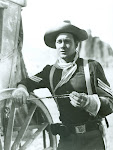
Fort Bowie was released starring Ben Johnson and Kent Taylor. Best known for his supporting roles, this was one of Johnson's few leading roles. Here he plays a cavalry officer sent on a suicide mission against the Apache by his commanding officer, who thinks Johnson is having an affair with his wife. It's a minor Western, but as Johnson did with so many roles, he brings a real dignity to this one.
Today in 1964 marks the passing of Alan Ladd, who will be forever remembered by Western fans for his performance in George Stevens' 1953 classic Shane. Here's the ending, courtesy of Youtube:
The movie Montana was released, starring Errol Flynn. For the first and only time in his career, Flynn plays an Australian, a sheepherder making his way in cattle country. This was Flynn's second to lat Western, and it's a bit sad to watch, because a lot of the magic and the charm from the earlier movies is gone. By this time, Flynn was also drinking more heavily, and the effect on his physique is evident. Nevertheless, I would say that any Errol Flynn is better than no Errol Flynn, and here's an excerpt from the movie:
Apache Drums was released. Starrin Stephen McNally and Colleen Gray, McNally plays a gambler thrown out of town who tries to convince the townspeople that the Apaches are really coming.
Escape from Fort Bravo was released, directed by John Sturges and starring William Holden. During the Civil War, Holden is the hardbitten cavalry officer in charge of a prison camp guarding Confederate POW's while also having to deal with Apaches on the warpath. Eleanor Parker is the love interest, and Dynasty fans will recognize John Forsythe as the Confederate officer planning the escape from Fort Bravo. The Encyclopedia of Western Movies describes this as a "modest and effective film." Sturges would go on to direct many fine Westerns such as Gunfight at the O.K. Corral (1957), The Law and Jake Wade (1958), and The Magnificent Seven (1960). Here's the trailer:
Henry King's The Gunfighter was released, starring Gregory Peck. The Encyclopedia of Western Movies describes it as a "seminal Western" which introduced a new theme to the genre, that of an aging gunfighter trying to put aside his lifestyle and settle down. More than that I won't say except to recommend it if you haven't seen it. Here's the trailer for the movie from 1950: